Through Dungeons Deep

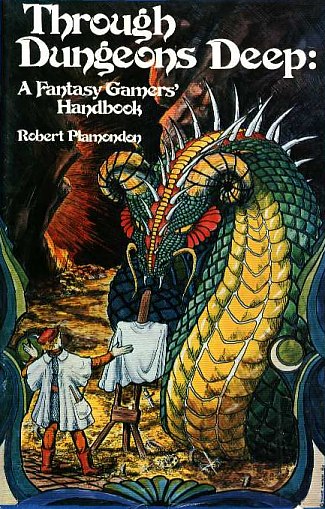
A Fantasy Gamers’ Handbook by Robert Plamondon

through_dungeons_deep
Buy on Amazon.
Compare Prices.

Reissued by Norton Creek Press. 340 pages. ISBN 9780972177078

  • Learn how to play D&D and other fantasy role-playing games
  • Learn how to be a Dungeon Master
  • Learn how to design your own fantasy campaigns
  • Tips and tricks for every occasion
  • Great companion for anyone interested in role-playing’s old-school revival

From the Author: I spent a good fraction of my college days playing Dungeons & Dragons when I should have been studying. In the process, I discovered a wealth of ideas and techniques in how to play well and be a good Dungeon Master. I wrote these up in Dragon Magazine and others. One day I discovered that my list of topics looked more like a table of contents than a list of future magazine articles, so I began writing Through Dungeons Deep.

The book went out of print when Reston Publishing went out of business. But demand for the book has never died. The original edition is being reissued by Norton Creek Press for far less than the going rate for the original Reston edition, which often sells for over $50.

The Book That Would Not Die. I still get fan mail like this:

Robert,
Just a note to wish you and yours a happy holiday, and to tell you how much I enjoy “Through Dungeons Deep” (the reprinted edition). Although I’m a DM with many years of experience, I still find new and insightful ideas in every chapter. The bits about your personal gaming group and characters are especially fun to read as well. I look forward to recommending it to my friends, who will undoubtedly enjoy it every bit as much as I have.
Best wishes,
Todd Rooks
Barberton, OH

Testimonials like this tell me that I was right to come up with a book that ignores game mechanics and focuses on what fantasy games are all about — playing roles, creating worlds, and having a great time. These require that you develop skills that have nothing to do with understanding the rules. I show you how to do this.

Works With Any Rules System. This concept has withstood the test of time very well — I started out with Basic Dungeons and Dragons, but used Original Dungeons & Dragons plus Greyhawk and Advanced Dungeons and Dragons, too. Later I ran customized campaigns based on a now-forgotten rules system called High Fantasy, and played in campaigns running under any number of rules systems — Rune Quest, Traveler, Paranoia, any number of newer D&D editions, plus all sorts of other games. Right now I’m running a little campaign using my much-annotated Original D&D booklets. It’s all good, and my book is relevant to all of them, though it covers fantasy role-playing games better than other genres.

Old-School Renaissance (OSR). Everything old is new again, and there has been renewed interest in the classic role-playing systems and the classic techniques in playing them well.

I hope the book will help a new generation of players and Dungeon Masters learn the ropes more quickly, and get more excitement out of the game. With all the emphasis these days on the different flavors of Dungeons & Dragons, people sometimes lose track of the fact that the rules are really of secondary importance. Everything important is really up to the players and the Dungeon Master, and we all need a little guidance to start moving down the right path. You definitely want to buy this book if you’re new to playing or dungeon mastering, or have some beginners to bring up to speed, or could use a few more tips.

So take a look at the sample chapters and scan the table of contents below. Look good? Then Buy a Copy!

Sample Chapters

Table of Contents

Part I: How to Play

Chapter 1. What are Fantasy Role-Playing Games?
Chapter 2. Getting Started
Chapter 3. Characters and Characterization
Chapter 4. Outfitting Your Character
Chapter 5. Home Bases and Travel
Chapter 6. Exploring Dungeons and Ruins
Chapter 7. Creatures and Combat
Chapter 8. Treasure
Chapter 9. Magic
Chapter 10. Wealth and Power

Part II: Game Mastering

Chapter 11. Becoming a Game Master.
Chapter 12. Design Philosophy.
Chapter 13. Creating a Campaign.
Chapter 14. How to Referee
Chapter 15. Nonplayer Characters and Monsters
Chapter 16. Traps, Treasure, and Magic
Chapter 17. Combat

Part III: The Complete Campaign

Chapter 18. World Design
Chapter 19. Scenarios
Chapter 20. Altering the Rules
Chapter 21. Keeping Up With the Players
Chapter 22. The Gods
Chapter 23. Conclusions

Appendix

Miniature Figures

Related Content

How to Order

Chapter 14 of Through Dungeons Deep: How to Referee

Through Dungeons Deep: A Fantasy Gamers’ Handbook

Part II. Game Mastering

Chapter 14. How to Referee

Knowing the rules and having a campaign aren’t enough; you need to muster props, master techniques, and put on a memorable show.

Setting Up the Game

As Game Master, you have the responsibility of coming up with enough chairs, popcorn, and pencils for the adventure. You have to have all the material goodies ready for play, so it can go on without interruption.

A Place to Play

Although it doesn’t take much in the way of furniture or props to run a fantasy game, what is necessary shouldn’t be ignored.

You will, of course, need to find a place for your game. The main requirements are good light (especially if you have one of the rulebooks printed in microscopic type), a sufficient number of chairs, access to a bathroom, and a playing surface.

The playing surface varies according to the type of campaign. If you don’t use miniature figures, then all you need is a place to put the campaign map, character sheets, and dice. If you use miniature figures, then you need room to deploy them as well.

I have found from experience that there are several places where fantasy role-playing games work poorly, if at all. One is outdoors. Unless the air is absolutely still, the wind will blow the paperwork away, and all the maps, character sheets, room descriptions, and notes add up to a lot of paper.

It is also unwise to play where there are a lot of passers by. Fantasy role-playing games have a tendency to attract spectators and the spectators tend to disrupt the game by asking questions. If you play under these conditions, try to appoint a victim to answer the spectators’ questions or the game can slow to a crawl.

Tools of the Trade

There are a lot of props that GMs pretty much have to have.

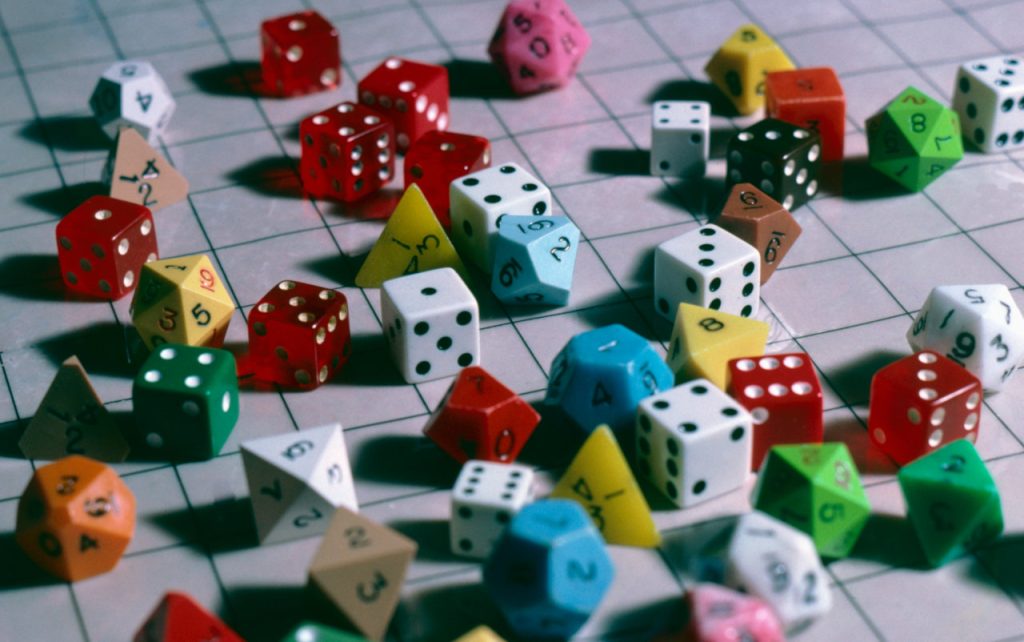
Dice. One is dice. There is no such thing as a GM with too many dice. Most of the games use a variety of dice with 4, 6, 8, 10, 12, or 20 numbered faces. Even the games that only use conventional six-sided dice require large numbers of them.

Dice are used in combat, for random events such as wilderness encounters, for paper weights, or markers (monsters can be represented by dice when there aren’t enough figures, or they can be trees, rocks, or treasure chests). Since they’re often needed for several jobs at once, a large number of dice helps speed up the action.

Paper. Paper is necessary in all role-playing games. The players need to write down lists of treasure, notes on features they might forget, maps, and notes to both you and the other players when trying to keep some action secret. You need a pad of quadrille paper and some smaller sheets for notes.
Character Sheets. Character sheets, which can be either printed forms or plain sheets of paper, are vital for keeping track of the characters’ abilities and possessions. Printed character sheets work best; they save time and present information the same way for each character.

Pencils. Players are totally incapable of bringing a pencil to a game, although they’re perfectly willing to take your pencils home with them. Yield to the inevitable and buy a large number of pencils and bring them (sharpened) to every game. They’ll soon vanish but the game won’t stop every time someone wants to write something down.

GM Screens. The characters shouldn’t be able to see your notes or the results of your die rolls. Many Game Masters use a screen made of cardboard to block their end of the table from the players view. There are commercial GM screens for a few of the games; these have game statistics on the inside, which lets the GM find information without leafing through the rulebook.

Miniature Figures
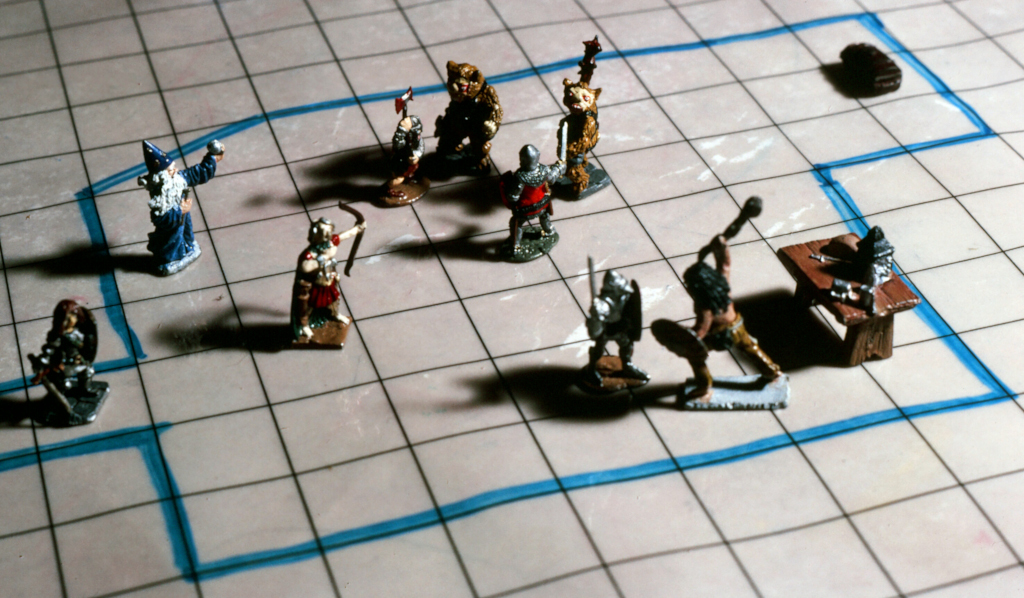
Many campaigns make use of miniature figures. Miniatures are small lead castings, usually about an inch tall. Fantasy miniatures are available in an amazing variety of character figures, covering practically every conceivable combination of arms and armor for both sexes. There are also miniatures representing a huge array of monsters.

Miniatures come unpainted and are painted by their owners. This forms a hobby in itself.

The advantage of using miniature figures is that they give the players some visual information as well as narration. Players are often confused by verbal description; many rooms are difficult to describe quickly and the players have difficulty keeping track of the positions of their characters, let alone everyone else’s.

With miniatures and a good playing surface, the Game Master can draw in the terrain and the players can place their characters figures in the room. Everyone can see what’s going on and play is more orderly.

There’s nothing to keep you from using something other than lead figures for this purpose. I used to use chess pieces labeled to show which piece represented which character. Any marker will do. But miniatures have advantages. For one thing, you can be fairly sure of the scale when using miniatures; distance can be gauged in relation to a figure’s height. This doesn’t work with chessmen.

Furthermore, miniatures look like people and promote identification with the character. In fact, some of my figures have such a strong association with a particular character that I won’t let them be used to represent anyone else. A miniature gives everyone a mental picture of the character. The net result is better role playing.

Finally, miniatures make the situation look realistic. It is easier to create a mental image of a conflict if you have something to work from. It is especially easy to picture a dungeon setting when the characters and the outline of the walls are in front of you. And when a huge dragon figure is plunked onto the board in front of your puny character, you don’t need more than your eyes to know that you’re in big trouble.

Battleboards

Miniatures are of little help if you can’t draw in the terrain. A playing surface that shows terrain in the same scale as the miniature is called a battleboard.

Paper. A simple battleboard is a large sheet of paper. The GM draws the terrain on it, usually during play. When the players look into a room, the GM draws what they see. Nothing is known about the terrain until the player characters can see it.

Preparing a complete map beforehand saves time during play, but this lets the players see unknown terrain before their characters get there. Since part of the fun lies in exploring the unknown, putting a complete map on the table kills the thrill of exploration. Covering the unknown areas with Post-It Notes can help avoid this problem.

One advantage of using a big sheet of paper is that you can keep it as a grisly memento of a battle by drawing in a little stick figure every time something is slain. Particularly blood-soaked expeditions can be memorialized by being hung on the wall.

The problem with paper battleboards is that they aren’t easy to erase. If the drawing is done in pen, all mistakes are permanent. In addition, long expeditions use up a lot of paper.

Formica Boards. Light-colored Formica tabletops or whiteboards make good battleboards; grease pencil and water-soluble pen work on them and the map is easily erased or corrected. Whiteboard markers are less satisfactory because the lines tend to get smudged during play, often to the point of complete erasure.

Still, drawing on these surfaces involves a lot of measurements and lines drawn with a ruler. The amount of time involved in drawing even simple rooms can be quite large. When I used Formica sheets for my battleboard, the worst time waster was measuring room dimensions with a ruler.

The Grid System. The way to get around this is to mark off your battleboard in squares; one square to the inch is the most common. The grid lets you get the lines parallel without a straightedge and lets you make them the right length without measuring anything. This doubles or triples the speed with which rooms are drawn.

If you have access to a large-format printer or plotter, you can easily print out your own paper grid sheets.

Laying out a grid with a permanent marker on a piece of Formica or a whiteboard is pretty easy. Use a T-square and work slowly.

Cardboard Cutouts. This method is a one-shot proposition but has some advantages. Instead of drawing the room outlines during play, you can make them in advance by cutting them from poster board, with a separate piece for each room. Room numbers, objects, and initial monster placement can be drawn on the pieces so everything will be ready in advance.

When the adventurers come to a room, the cardboard cutout is placed on the table next to the room they just left. This is fast and accurate.

These cutouts can be used in less space than conventional battleboards, since room cutouts can be removed from the table when the adventurers leave a room. You could do this by erasing your battleboard every couple of rooms, but that would be too slow.

This also gives the adventurers every opportunity to get lost, since the room pieces disappear when the characters move on. When the whole map is drawn on the battleboard, the players have a map of their travels right in front of them—at least until the GM runs out of space, erases the map, and starts over.

I have never used cutouts for anything but floor plans; there isn’t much incentive to use them for outdoor scenes. I tend to cut a new set for each adventure but, since many rooms are alike, they can be saved for use in future expeditions.

Munchies

The typical gaming’ session ends in a wasteland of empty pop bottles, candy wrappers, pizza boxes, and bits of popcorn. Junk food and fantasy games go together.

After experimenting with various schemes for providing munchies, I have concluded that anything more elaborate than soft drinks and popcorn is both too distracting and too expensive for all but the filthy rich.

Having nothing at all doesn’t work, since after a few hours of play everyone begins to get hungry. If you want to keep playing, food will have to appear from somewhere. If not, then having an empty larder may be a good stratagem for getting everyone to go home at a reasonable hour.

If you manage to find chairs, tables, pencils, and munchies and have your scenario blocked out and your dice in hand, you are ready for the next step: dealing with the players.

The Adventure

At some point, the players will arrive, At the beginning of the campaign, they will be blissfully ignorant of the nature of your world and the scenario will have to be described to them. They probably won’t have any suitable characters. If they are experienced players, they may try to persuade you to let them play an unsuitable character from another campaign. If they are novices, they will need help. In any event, chaos will reign.

The easiest way to keep the confusion level down is to have only a few players. I am comfortable with six experienced players. Three or four is ideal; everyone can keep track of what everyone else is doing and everyone has a significant piece of the action. With more players, the game gets noisier and the shy players tend to be lost in the shuffle.

Getting the Players Ready

One way to reduce the confusion is to give the experienced players a description of the campaign several days before the game. This will give them time to come up with an appropriate character. Let the players generate their characters’ ability scores; you have more important things to do than look over their shoulders to see if they’re cheating on the die rolls.

Novice players should be given a small selection of pre-rolled characters to choose from. These characters should be described on simplified character sheets, which ignore all of the complicated statistics and just give the basics. The sheets should also avoid abbreviations; all gaming jargon should be spelled out and explained.

Some GMs like to hand the players personality descriptions of the characters and expect the players to fall into the role. This may be acceptable for novices, who are too busy trying to find out what’s happening to develop their character. On the other hand, it can offend experienced players, who figure that characterization of player characters is none of the GM’s business.

They’re right, too. Finding a comfortable role is the player’s responsibility and the GM should only step in if the player is having difficulty—and then only as an advisor—or if the player has chosen something totally incompatible with the campaign.

Players often want to run characters from other campaigns. This sometimes happens because the player always runs the same character, regardless of circumstances. Sometimes a player has a character who is stranded; the campaign he was in no longer exists or he or the GM moved.

Don’t let a habitual world hopper bring his character into the campaign. He’ll just leap back out again, play in 17 other campaigns, and return to your next session with ridiculous amounts of treasure, magic, and power.

Letting players get away with this is unfair to the other players and to your campaign, since the world hoppers inevitably obtain world-wrecking power in some Monty Haul campaign or other.

You can, however, let them run a “clone” of their character, someone who is identical in physical ability and personality but was born in your campaign. This way the player can fall into a familiar role, but won’t be able to bring his other character’s goodies in or take his new character out of the campaign.

Stranded characters are less of a problem. You can either use the clone excuse or think up a reason for their sudden appearance in your campaign. If the character has too many powerful magic items, take them away from him. If he has too much magical or combat skill, take enough away to put him on about the same level as everyone else. If the player doesn’t want to take this kind of beating, he can always start a new character. Hopefully, he wants to play the character because he likes the role, not because of the nifty loot he has obtained, and the loss of goodies and combat ability won’t bother him much.

Background Information

The players should have enough information about their own culture to let them work out their characters’ personalities before anything else happens.

They need to find out enough about the adventure to outfit their characters. Tell them as much about the area around the adventure as you think would be common knowledge and start play with their discovering a chance for fame and fortune.

Any characters that didn’t suddenly appear from another world will know many things about your campaign; growing up in the campaign world exposes them to a great deal of information. Thus, you can’t assume that beginning characters are ignorant of such things as the local government, monetary system, or common wildlife.

On the other hand, the characters are ignorant of the players knowledge. The characters don’t know anything about submachine guns, microwave ovens, or the germ theory of disease. They may well be illiterate and any math more complicated than counting may be beyond them. However, they would have some knowledge of many crafts that are now largely unknown. The characters are creatures of the fantasy world, not this one.

Narration

This is one of the most crucial elements of the campaign. A GM with a good narrative style can get away with murder, while truly lousy narration can ruin anything.

The Game Master tells the players what their characters see, smell, hear, feel, and sense. Some of this can be done with props (miniature figures, sketches, and maps) but most of the information is verbal. The Game Master describes everything that happens and should do it clearly and concisely.

This is a tall order but is by no means beyond the average person’s grasp. Most people can tell a good story if they have chance to prepare for it and avoid the most common pitfalls.

Write things down before the adventure. It is easier to write a good description in advance, when no one is waiting, than it is to come up with one on the spur of the moment.

Visualize. It’s impossible to describe something well if you don’t have a grip on it yourself. Try to picture terrain as being real rather than just marks on the map. Imagine what your dungeon really looks like to a torch-bearing adventurer. It’s too easy to treat the encounters as abstract concepts because they are. Still, they’re supposed to feel realistic. So picture the scenes carefully.

Describe in detail. If you haven’t written any details in your notes, make some up. Everything should have at least enough detail to move it from the generic to the specific. A minor heap of treasure should never be “a minor heap of treasure,” but something like, “a rotting yellow carpetbag with greenish copper coins that have fallen out of rips in the side, with here and there a silver coin, tarnished almost to black” or “a nest about four feet across, made from straw and sticks and fragments of shattered furniture, with several inches of beautifully polished copper coins and bits of ironmongery at the bottom.”

Be concise. This does not really clash with detail. You want to tell them what’s going on and what’s around them. You don’t need to count the bricks in the floor for them. Try to describe things fully in a few words.

Don’t identify unknown objects. The players may run into a magical device, for example. Tell them what it looks like; don’t tell them what it is. “A blackened shortsword with a disturbing gargoyle face with ruby eyes on the pommel,” not “a +2 shortsword, +4 against trolls.” If they should know a legend about it, you should tell it to them before the adventure starts, not when they run into it.

Don’t identify unknown creatures. If the players have never seen a Minotaur, don’t announce, “You see a Minotaur;” say, “You see a monster that looks like a huge, hairy man with the head of a bull.” Similarly, a werewolf in animal form appears to be a large wolf and in human form looks like a human.

Don’t give hints. Try not to grin evilly when the characters are about to die. Don’t look dismayed when they demolish your best trap without noticing it. Keep your secrets to yourself and the players will never know if they’re safe or not.

Dramatization is what makes campaigns fun. Action should be interesting and your job is to make it interesting.

Combat, for instance, can be run on a “he hits, then you hit, then he hits again” basis, where the mechanics of rolling dice dominate the action. This sometimes manages to be exciting in spite of the GM.

A good GM throws in details and actions that aren’t strictly necessary. The “he hits, then you hit” narration can turn into “He slashes down at your head. You duck, but he nicks your shoulder. Before he recovers, you manage to slash him in the leg…

Jazzing Up the Action. But dramatization doesn’t stop there. Jazzing up the blow-by-blow is nothing compared to jazzing up the action itself. Make the opponents interesting; think up sneaky tactics for them, give them nasty surprises. Be creative.

Think of swashbucklers when you narrate the action. Make it build. Steal ideas from movies and novels.

For example, assume a few adventurers are trying to kill off a group of plunderers who have taken over a large stone church. The initial assault was successful; in a few bloody rounds of combat, entry was gained to the church and the main body of bandits was slain. Many of the adventurers were wounded.

Just when the battle appears to be over, the bandit leader and his two lieutenants appear in a side entrance. Battle is again joined, with the head adventurer taking on the bandit leader.

Swords flash and the two bandits are dispatched, wounding their opponents before they die. Their leader begins to retreat up the stairs to the second floor, followed by the player characters leader.

Several minutes of combat see the bandit leader and our hero still fighting. The bandit leader manages to slam a door in his opponent’s face and races to the belfry.

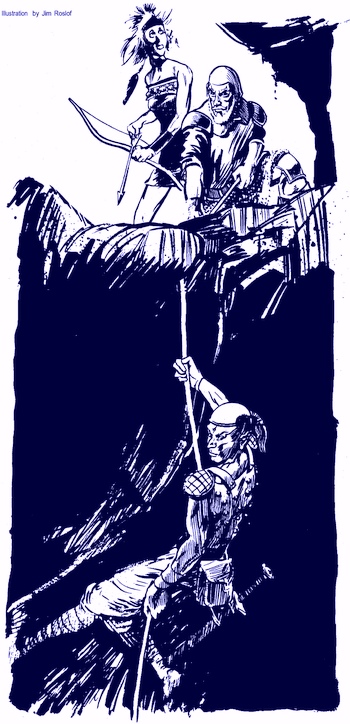
Before he can slide down the bell rope to safety, our hero catches up with him. The fight rages a hundred feet above the cobbles, neither man able to press his advantage.

The bandit gets the bell between him and the adventurer.

He gives it a push; our hero is knocked off balance and falls. He catches the ledge and hangs a hundred feet in the air.

The bandit, bleeding but triumphant, stomps on our hero’s left hand. The fingers break and he can only hold on with his right. As the bandit moves to stomp the other hand, one of the wounded adventurers, who had crawled up the stairway, shoots the bandit in the leg with a bolt from his crossbow. The bandit falls screaming to his death and the archer somehow manages to pull his friend back to safety.

Do such complicated cliffhangers really happen in fantasy games? Yes, but only when the GM is on his toes. A GM who wasn’t looking for good bandit strategies would never have thought of sliding down the bell rope. In fact, most encounters would be too weakly visualized for the GM to have realized that churches might have bell towers, and bell towers have bells and bell ropes, and these facts might come in handy.

Bending the Rules. Looking for chances to add spice to the action is the most important step; the rest occurs fairly naturally. The major exception lies in the realm of bending the rules.

In the example above, there are several points at which the rules aren’t going to cover the situation very well. How easy is it to catch someone with a carefully times shove of a bell? What are the odds of catching a ledge on your way out of the belfry? Well, it all depends. Do rule systems have a specific way of handling the effects of a villain stomping on your fingers? Not really. So to a large extent the GM is on his own, anyway.

The easiest way of dealing with these situations it to roll dice but not pay any attention to the result. This gives the impression that you’re following standard procedure, when in fact you’re running on pure improvisation. But I rarely stoop to this myself.

Almost as good is to assign a high probability of success for whatever outcome you think is most interesting, but roll dice to see if something else happens anyway. If the villain shoves the bell at our hero, but the dice say he fails utterly, perhaps he gets hit by the returning bell and knocked out of the belfry, or perhaps he shoves the bell too far and overbalances and falls down the hole in the belfry floor through which the bell-ropes pass. If he succeeds very well, our hero is going to be flung out of the tower as desired, but maybe a steep roof or a cartload of manure will break his fall, and he doesn’t actually die.

As a general thing, rules systems kill off characters more often than they should, and leave them incapacitated less often than they should. In real battles, the ratio of killed to wounded is often ten to one, but you don’t often see this in fantasy role-playing games. And don’t think that having to be nursed back to health doesn’t have its upside. The gallant soldier being nursed back to health by the beautiful young nurse (often a princess) is a plot element as old as time. If the battered hero isn’t careful, he’ll be sweet-talked into going a quest far more perilous than the one that broke both his legs as soon as he can hobble again.

But I digress. The rules should be bent creatively but quietly, without any obvious fudging. The basic tools of rule-twisting are:

Giving second chances. Things that you don’t want to happen can be divided into a series of actions, each with a separate die roll, rather than just one. This tends to reduce the odds of the undesired result happening, and by stretching out the time involved from, say, one combat round to three, the other player characters have a better chance of coming to the aid of their beleaguered comrade. Alternatively, chances for last-minute saves can be invented, such as falling against a narrow ledge or a gargoyle just below the belfry.

Altering outcomes. Having the falling hero land on a passing manure cart instead of on the cobblestone street probably uses too much slapstick for this scenario (but it’s a great gag and you should be sure to use it someday under more favorable circumstances), but crashing through the roof of an unregarded shed on the side of the belfry, coming to rest on a heap of old sacks will work okay, especially if he breaks a few bones in the process. No one will quibble. Alternatively, a very unfavorable die roll can be interpreted not that the hero is flung out into space, but is hammered between the bell and edge of the belfry window, doing unpleasant things to his ribs and causing him to slump unconscious to the floor of the belfry, but not fall to the cobblestones.

Is this cheating? No, and it won’t occur to anyone to even ask the question–at least, not if your modified outcomes are sufficiently painful and inconvenient.

Flow of Events

When nothing much is going on—such as during a journey through civilized territory—the flow of game time should be sped up as much as possible. A journey through peaceful farmland might be accomplished by rolling dice once to see if anything unusual happened; if not, you simply announce, “The journey passed uneventfully.”

As the chance for action gets larger, the intervals of time that can be swallowed at a gulp get smaller. In monster-ridden forests, encounter dice may be rolled as often as once an hour. When an encounter actually appears, time suddenly gets divided into tiny slices to allow individual action on a moment-by-moment basis.

There are two reasons for this. First, to keep the game exciting, the boring parts should be disposed of as quickly as possible. On the other hand, the exciting parts involve danger and the players want to be able to do intricate tasks. These can’t be done on a broad time scale; asking a warrior what he does in the first day of a duel is ridiculous. Dividing the time into chunks much larger than a minute is questionable–combatants can do too much and it becomes impossible to referee. Realism demands small increments of time during combat.

Like almost everything in role-playing games, this can be overdone. I know of one campaign that broke combat down into two-second rounds. The players nearly died of boredom since it took an hour to kill a healthy rat and four to drive off a band of Orcs. The conflict between pace and realism should not be forgotten.

As a general rule, keep the game going as fast as circumstances permit. This may give a breathless air to the expedition, but that’s all for the good.

Have a short break every couple of hours. If you don’t, the players become fidgety, the search for more munchies goes on during combat, and the game deteriorates in general. A 10- or 15-minute break will usually get the munchies and gossip out of the way and the game can proceed.

Chatter

Players talk a lot. If the game isn’t going quickly, or their character is out of action, or if they have any other excuse, they ignore the game and chatter. I know, because I’m one of the worst offenders.

The best way to curb chatter is to have a campaign that is so fascinating that no one would dream of ignoring it for a second. I am realistic enough to look for other methods.

Screaming for quiet doesn’t work. Most gainers are rampant extroverts; they scream right back.

Keeping Up the Pace. Keeping the pace up helps a lot. If something is happening every minute, it is dangerous for a player to ignore the game even for a minute or two. This is perhaps the best method.

Talking in Character. Getting the players to talk in character helps, too. Once you have them convinced that speaking in character is good role playing, the chatter starts coming from the characters rather than the players. The noise level is just as high but at least everyone is paying attention to the campaign. Besides, it is good role playing.

Kibitzing. A related subject is kibitzing. As soon as someone is in trouble, the players will all shout advice at each other. This is true even when the endangered character is beyond earshot of the party.

One way to discourage kibitzing is to announce that characters can’t act on advice given out of character. Thus, if one player suggests a plan to another, the character can’t act on the advice unless the other player’s character could have suggested it.

This can cause hard feelings since several people often come up with the same plan and disallowing it because some idiot shouted it out is not really fair. Still, if the rule is made clear to the players in advance, most of the blame will fall on the loudmouth, not the GM. And it does work.

Rewarding Ingenuity

Campaigns in which everyone uses swords rather than brains become monotonous after a while. Although there is quite a variety of opponents, there is a limit to how much enjoyment can be obtained from slicing up imaginary creatures with imaginary swords.

To keep the campaign from dying through lack of interest, you should encourage the players to solve problems by cleverness. This can be done by the simple expedient of placing monsters that are too hard to kill but have valuable treasures. The players will have to resort to thinking their way out. There is generally some way of disposing of unwanted monsters, and, given the incentive, the players will almost always find one.

It actually isn’t necessary to set up opportunities for player ingenuity; all you really have to do is convince them that it works and then not punish them for trying.

Some Game Masters resent being shown up by the players and rule that any trick the players try automatically fails. This is pointless and destructive. The players should be allowed to do anything a person of the character’s background would reasonably be able to do. That’s what makes the game realistic.

If you don’t know exactly how to referee an action, ask the players. Sometimes they’re honest. Nod sagely, assign a chance for success, roll the dice, and announce the result. Don’t tell them what the chance of succeeding was since they’ll just argue.

If it looks like a particular trick is going to come up more than once, you’ll need to work out some guidelines. This is rarely difficult, since common-sense rules are generally accepted by the players. If they insist on intensive research, and you don’t want to do it yourself, point them at the library and wish them luck.

These special situations come up all the time in good campaigns because the players are always plotting and scheming and doing it in character. A good role player never works on the assumption that if it isn’t in the rules, it can’t be done; he knows better. Besides, using the subjects covered in the rulebook as a guide to character actions is poor role playing. The decisions are supposed to be made from the character’s viewpoint and the character is unaware of the existence of the rulebook. He is under the impression that he is living in a real world and should act accordingly.

Punishing Stupidity

This rarely takes more than curbing the urge to be merciful. When players go in over their heads due to their own carelessness, they deserve to suffer the consequences.

Don’t fudge the die rolls, don’t make the monsters fight poorly, and don’t arrange convenient miracles; just do what you intended to do in the first place.

Occasionally a player will do something so incredibly moronic that he deserves special punishment. Typically, the player offends some monstrously powerful being, profanes a church, or does something equally foolish.

Again, no special action is necessary; just let the outraged party act naturally and wreak vengeance on the player. If you’re feeling mean, you can delay vengeance for a while and then hit the character when he thinks he’s safe. Overwhelming pride offends the gods and they generally have no qualms about squashing foolish mortals. Make sure the player knows why his character is getting stomped since he’ll take offense if he thinks you’re just being vicious.

Keeping Secrets

There are many times when you will want to withhold information from the characters. Many of these are obvious; you don’t want the players to know the statistics for monsters the characters have never seen, for instance. There are other, less obvious places where secrecy is important.

Take a character who is searching for traps. The player knows the character’s chance of finding a trap. If you let the player roll the dice, or roll them yourself in plain sight, you’ll give away some secrets. If the roll indicated that the detection succeeded, and you announce that no trap was found, the players know there are no traps, since the dice indicated that any traps that were there would have been found.

The players shouldn’t know this. If you tell them they fail to find a trap, they should still be in some doubt: is the area safe or did the dice say the trap wasn’t found?

This principle should be applied to all situations where looking at the dice can tell a player something he wouldn’t otherwise know. All such die rolls should be rolled by you in such a way that the players can’t see the numbers. Just announce the result.

Similarly, you don’t have to explain the motives of NPCs. Just have them do what they want to do. Let the players know only what they see and hear. If they think your NPCs are acting irrationally, don’t argue with them. Just point out that there are a lot of irrational people in the campaign world.

When to Quit

Sometimes the difference between a good playing session and a poor one is that the successful GM knew when to quit, while the other kept his game going hours beyond the point of boredom. Role-playing games are fun but the thrill wears off during extended play.

The easy way to keep the players from nodding off is to have relatively short game sessions. In my experience, four hours is short, six is about average, and anything beyond ten is unreasonable. Marathon games tend to be more of a test of endurance than an attempt to play an exciting game. They are, in my opinion, justified only at conventions when you probably won’t see the players again for a year.

If you keep the game down to six hours during a weekend, with a short break every two hours, then the players will be able to survive. This is important because as soon as the players get tired of the game or tired physically, they start doing silly things.

When the players get tired of the game, their characters become buffoons, the level of chatter goes up, the attention paid to the game goes down, and everything comes unraveled.

When the Game Master becomes tired, his concentration goes, he makes mistakes, and everything slows down. This encourages the players to become sillier and the slow pace practically forces them to ignore the action.

Watch for the symptoms of player unrest and, when they appear, stop the game. The players probably won’t agree; the fidgeting, chatter, and silly character behavior goes on for a while

before the characters recognize their own boredom. If you quit before they’re sick of playing, they’ll be eager to come back next time.

After the Game

When the main action is over, there is still a lot of work to do. The players will need to divide up the treasure (if they didn’t do it during the game) and total up the experience points or skill increases from their adventure.

You will have to supervise this, explain the function of mysterious items after the characters appraise them, describe the haul again, give the resale values, and generally sum up the results of the expedition.

In addition, the changes that the characters have made to your campaign have to be noted before you forget. It’s embarrassing to be unable to recall what the characters did on the last expedition and the characters resent running into a foe that you forgot was dead. Everything has to be brought up to date.

This is where the story-telling campaign bogs down. Between every expedition, the story-telling campaign is continuing. Armies move, court functionaries intrigue, people are born and people die, and all of this has to be taken care of.

In a conventional campaign, the stage is set and the NPCs are frozen into position until the characters blunder into them. Everything stays as it was until the characters change it. Thus, only the area immediately surrounding the characters has to be altered after the game.

Story-telling campaigns will survive anyway. The GM tends to enjoy the time spent on detail work and the campaigns are rewarding to play. To be best, you have to work harder; and I believe that story-telling campaigns have more potential, in the long run, than conventional campaigns.

Don’t put off the bookwork. I always do, and it never works. Get it done as soon as possible, or you’ll forget important details, lose sheets of paper with vital information, and louse things up in general.

When everything is more or less in order, you will be ready to prepare for next time. There may be a reaction to the mayhem brought on by the characters; the monsters and NPCs will not sit still for getting trounced time after time. The consequences of the characters’ actions need to be discovered and put into action.

How creatures react to the players’ characters depends on the circumstances, the players’ actions, and the monsters themselves. So far, the monsters and nonplayer characters have been largely ignored, even though they are a very important part of any role-playing campaign. The next chapter deals with these creatures—their functions, their roles, and ideas for integrating NPCs into the adventure.
Chapters 1-2 of Through Dungeons Deep

Sample Chapters from “Through Dungeons Deep: A Fantasy Gamers’ Handbook” by Robert Plamondon

Part I: How to Play

Chapter 1: What Are Fantasy Role-Playing Games?

Remember this from English Lit? As the men were sleeping, the monster burst into the hall. It seized a man, sank fangs into his throat,
and drank blood until there was no more. Then, it began taking huge bites from the still-warm flesh.

Not satisfied, it looked around for another victim and spied a large man in a nearby bed. It reached down its
hand to seize him but the man was not asleep. He took hold of the arm and grappled with the monster.

This man was stronger than anything it had ever faced before. Fear entered the monster’s heart and it tried to
pull away, to bite him, or rake him with its claws–anything to escape the awful grip. The man avoided the
attacks and concentrated on his hold on the arm, bending and twisting until the monster bellowed in agony.

The other men woke. They seized their swords and attacked the monster as best they could but their blades
bounced off its horrible skin. Ancient spells protected the monster from the cold bite of iron.

Slowly the hero tightened his grip and, finally, the monster’s shoulder burst, and the arm was ripped from its
socket. Mortally wounded, the monster fled screaming into the night. It would never kill another man. Beowulf
had slain Grendel.


This is the famous scene from the Medieval verse epic Beowulf. But the action could just as easily have taken
place in a novel, a movie, an opera, or a play. Or, it could have taken place in a fantasy role-playing game.

What are fantasy role-playing games? Answering that question was one of the most difficult problems in writing
this book because fantasy role-playing games are similar to so many things, but different from all of them.

Is This What You Have Been Looking For?

Have you ever wished you could be projected into the middle of a movie and take part in the action?
Role-playing games let you do just that. Have you ever read a book and wished you could create stories of
heroic deeds? That is the bread and butter of a fantasy role-playing game. Do you remember the fun of
childhood games of make believe? The excitement of playing Cowboys and Indians? Do you wish you could find a
game that didn’t bore you after five plays? Search no farther; fantasy role-playing games are what you’re
looking for.

A fantasy role-playing game (which I will also refer to as a “fantasy game,” “role-playing game,” or just
“game”) is a game where people assume roles of fictitious persons. To put it less pompously, they make believe
they are someone else. It’s play-acting, but structured play-acting with rules to make the game more
meaningful and more enjoyable.

A player might choose to play some strong but stupid warrior named Harald Bentnose. He gets to decide what
Harald is like–what kind of beer he drinks, whether he kicks his dog, goes to church, or respects the King.
The player is an actor, but he gets to make up his own role. Sitting around and talking about your character
is not what role-playing games are all about. The players need to have something to do with their characters.
To accomplish this, one player, known as the referee, Dungeon Master (DM), Game Master (GM), or Judge, is put
in charge of the game and is expected to come up with interesting things to do. The players then sit around
and talk about what their characters are doing.

I’ll use Dungeon Master or DM.

Creating the Campaign World

The Dungeon Master prepares by blocking out some kind of adventure. For instance, he can draw a floor plan of
a ruined castle, note where some horrible monsters have taken up residence, and suggest that the players’ characters (known, surprisingly enough, as the player characters) go on a monster hunt. The make-believe world created by the DM is known as the campaign world
and the adventures of the characters are the campaign.

On the monster hunt, the DM referees the actions of the characters. How long does it take to go from wherever
they are to the castle? The Dungeon Master decides. How do the players know what their characters see? The
Dungeon Master tells them. Who decides what the monsters are doing? The Dungeon Master. The players decide
what their characters are doing and the Dungeon Master determines whether or not it works, how long it takes,
how much it costs, and all the other details.

If the game were supposed to be a contest between the DM and the players, the DM would win every time because
he holds all the cards. But that is not what is happening.

The Challenge is the Thing

A fantasy game isn’t played so that a single character wins. No one is trying to beat the others. The idea is
to have a good time facing challenges and, hopefully, overcoming them–all as a group effort. Everyone works
together.

In many ways, the players are acting the roles of the heroes in a play and the DM plays everyone else, both
friend and foe. The idea isn’t to outdo the other heroes, but to bring the story to a happy ending. The DM
contributes to this process; he throws in the troubles that must be overcome but he also leaves opportunities
to overcome them. He is neither forcing the characters to win or abandoning them to die. He puts them in a
situation that, with skill, can be used to the players’ advantage. On the other hand, it can lead to disaster
if they fail.

There is no way to “win” a role-playing game in any final sense. The characters can become fabulously wealthy
and powerful or they can die, but neither event means that the player is a winner or a loser. The game itself
never ends though it often stops. Each playing session leads to another.

For example, suppose the players manage to kill all the monsters in the old castle. What are they going to do
with the castle? They may choose to fix it up and become the lords and protectors of the immediate area–and
collect taxes, of course. The next time the players get together, or the next six times, could be devoted to
fixing the castle, fighting off new beasties, and wresting taxes out of the local peasants.

If the players decided that their characters weren’t interested in a moldy old castle, they would do something
else. The Dungeon Master controls the world but he doesn’t control the player characters. The players alone
decide what their characters do.

Since players play the parts of people living in the Dungeon Master’s “world,” they try to make decisions as
if that world were real. The Dungeon Master’s main job is to make his campaign world seem to be real by making
things behave as one would expect them to behave. All of this is done sitting around a table, using verbal
description and imagination to describe what is going on.

But what about the rules? Role-playing games have rules, like every other game, but there’s a difference. In a
role-playing game you are trying to make-believe you are a character in another world. Interacting with that
world, playing the part, and being involved with the stories that come out of it are what make the game
enjoyable. The rules are there to help you do this. Since you can’t “win the game,” the rules can be fairly
loose, leaving room for change.

In fact, many of the more experienced Dungeon Masters don’t really need rules at all. They know how far a
horse can travel in a day and can referee a fight between a cave bear and an armored knight without reference
to any rule; they just wing it.

Now, I don’t do it that way and no one who doesn’t have a lot of experience should try it, but it does
illustrate the point that rules are much less important in a role-playing game than they are in other games.
There are more important things than rules, especially role playing, a good story line, a realistic campaign
world, and a skillful Dungeon Master, not necessarily in that order.

As a matter of fact, the secondary importance of rules is what allowed this book to be published. Good
role-playing technique is the same no matter which of the dozen or more role-playing games you are using.
Therefore, this book applies to every game.

Why Role-Playing Games are Popular

There are a number of things that make role-playing games as interesting as they are–interesting enough to
have sold millions of copies. These games are no fad. Their popularity is due to features that make them
superior to other games. These features include the following:

Role Playing

Playing a role is fun but it has previously been assumed that make believe is for children. Role-playing games
are games of make believe that can be enjoyed by adults.

Realism

A good role-playing campaign is amazingly realistic–a person can play without the slightest knowledge of the
rules. He simply has his character do whatever seems best according to what’s happening in the Dungeon
Master’s world. All he has to do is make believe that it’s real and have his character react accordingly.

Adventure, Excitement, and Romance

A description of what the characters do in the campaign sounds like the script from an Errol Flynn movie. The
characters gallivant around making friends, slaying enemies, and accumulating wealth and power. The games have
the excitement of a good fight scene, the audience participation of a play, and the swashbuckling story line
of a pirate movie.

Variety

Unlike other games, role-playing games are open ended. The characters can kill dragons, save nations, build
bridges, pick pockets, run an inn, or paint wallpaper. The possibilities are endless, limited only to the
imagination of the players and the Dungeon Master. The characters can hunt big game one week, rescue a friend
from prison the next, and solve a murder mystery the week after that. The variety possible in role-playing
games keeps them from getting dull.

What They Aren’t

These advantages make role-playing games very interesting and very enjoyable. Along with everything else that
is interesting and enjoyable, role-playing games have their critics. It seems that role-playing games are
destined to join television, pinball, and presweetened breakfast cereals as Great American Scapegoats.

If you are looking at this book because you want to find out about the “darker side” of role-playing games you
are in for a disappointment. The “darker side” is hype. Nobody plays role-playing games in steam tunnels or
goes nuts and believes he’s a Medieval hero. Sorry.

The people who believe that role-playing games are for unstable geniuses going off the deep end have been
conned. The ones who proclaim that role-playing games show “Satanic influences” are as credible as anyone else
who uses the favorite lines of the Ayatollah Khomeini. Role-playing games are engrossing and sometimes
thrilling, but they are no replacement for life and no one believes that they are.

Perhaps some of the bad press comes from the phrase “fantasy role-playing.” In recent years, fantasy has
become almost synonymous with “sexual fantasy,” and role playing is associated with psychiatric role-playing
therapy–so it sounds like a game for crazy perverts.

Who Does What?

There are two distinct types of players: the Dungeon Master and everybody else. The everybody elses are called
“the players.” This implies that the DM isn’t a player. He is, more so than anyone, as you will see in the
following descriptions.

The Dungeon Master

The DM is in charge of creating the campaign world which gives the player characters somewhere to live. He
creates all the inhabitants of this world, with the sole exception of the player characters. The DM plays all
the monsters and all the people except the player characters. He decides what the weather is like. He
adjudicates combat. He does everything–almost.

How does he do all this? How does he make all these decisions? A lot of this book was written to answer those
questions, but for now let it go at this: the DM sets things up as he likes them–but, for events that could
hurt the player characters, he rolls dice.

Dice are always present in role-playing games. In combat, determining whether you hit an opponent with your
sword is done by rolling dice. The result of his return blow is done the same way. The world is not completely
predictable and this is reflected in role-playing campaigns by the use of dice at crucial times.

The Players

The players don’t design worlds or monsters. Each player has a character and is in charge of playing him in
character, making decisions, and doing things according to what is going on in the game.

It sounds like the DM does all the work and the players are just along for the ride. This isn’t true. Playing
a character well can easily engage your full attention. The players are busy when they play their characters.
The DM has enough things to do so that he can’t outguess the players. They can scheme all the time, but the
DM’s attention is divided between all his various tasks. The result is that the players almost always do
better than the DM expected. Players have time to be sneaky.

Who Has More Fun?

My experience is that playing is more fun but DMing is more interesting. Both roles are entertaining and I’m
not sure which role gives me more pleasure in the long run, though some people have a strong preference for
one or the other.

What are role-playing games? They’re a structured exercise in make believe. The next chapter takes a look at
this structure and gives some information that will help you get started as a role player.


Chapter 2: Getting Started

Fantasy role-playing games are not played in caves or steam tunnels, regardless of what the news media says.
Like other games, they are played on a table or on the floor, typically in the Dungeon Master’s living room.
An unusual feature is that the Dungeon Master has a lot of material that the other players aren’t supposed to
see, so he tends to screen his end of the table from view or work from a different table. This preserves the
DM’s secrets until the time comes to spring them on the unsuspecting characters.

Sequence of Play

Acquiring a Player Character

There is a general procedure that novice players go through when joining a group of gamers. Before the
expedition can begin, the new player must acquire a player character. The new character must have physical
characteristics and possessions defined before he can be played. To give a random set of attributes, the
physical characteristics are generated by rolling dice. (This will be discussed in greater detail in Chapter
3.) The character starts with a small amount of money with which to equip himself.

All of the information on the character’s abilities and possessions has to be put down in writing, usually by
filling out a printed character record sheet. With this bookkeeping done, the new player is ready to begin.

Setting the Stage for the Adventure

The Dungeon Master then explains the essentials of his campaign to the new players. All of the players should
be introduced to each other and all of the characters should be described to the players. This lets the new
player know something about the characters with whom his character is associating.

When the adventure begins, the Dungeon Master will explain where the characters are and what is going on
around them. In a continuing campaign, the experienced players will already know most of this information
since the DM’s narration will begin where play stopped last time. Relevant information such as the weather,
the political situation, and offers of employment will be given to the players. The players, having been
brought up to date, will begin to plan their next actions.

The Dungeon Master is in charge of his entire fantasy universe, including the player characters. The DM can
tell a player that his character is unable to invent dynamite, for example, because the character lacks the
background necessary for developing such an idea. A good DM, however, will leave the player characters to the
players as much as possible. When a DM starts meddling in other people’s role playing, the players are
justifiably angered. A player character is supposed to belong to the player and the Dungeon Master should
interfere only when the player is having his character do something clearly impossible according to the
structure of the fantasy world.

All of the creatures encountered by the players are referred to as either monsters–the creatures encountered
in hostile territory, some of which are human–and nonplayer characters, or NPCs–the creatures that the
characters deal with in social (noncombat) situations. Both monsters and NPCs are run by the Dungeon Master.

Narrating the Events

Since the DM is in charge of the details of his fantasy world, he is required to narrate events as they occur
and to referee the actions of the player characters among themselves, and their interactions with the other
creatures in the fantasy campaign.

A role-playing game involves a lot of verbal description by the Dungeon Master. In some campaigns, no other
props are used. The DM describes what the characters see and the players describe what their characters do. If
they feel that it is important, the players may make notes and draw maps but, then again, they may not.

As an example of this style of play, let’s look at some dialog in a campaign with a Dungeon Master and three
player characters, a human, a dwarf, and a Hobbit. The Hobbit is a safecracker and cat burglar and wears no
armor; the others are warriors and have armor and shields. The adventurers have just finished looting the
tower of an evil wizard who was conveniently absent. They had a tough fight with the wizard’s household guards
and all are slightly wounded and more than a bit tired.


DM: About two miles from town, just before you leave the forest, a man jumps out ahead of you and says, “Stand and deliver!” He gestures to two bowmen, who step out from behind the trees and aim drawn bows at you.

Dwarf Player: What kind of bow?

DM: Short bow–not very powerful.

Human Player: Osric says, “Alright, alright, already. How much?”

DM: The bandit says, “Everything.”

Dwarf Player: Webli snorts and says, “We could take you before those puny arrows could get us. I’ll give you fifty sovereigns to spare us the inconvenience.”

DM: “Five hundred.”

Human Player. Osric says, “Look, we’re tired, and we don’t want to kill any more scum today, so here’s what we’ll do. We got a little goody today that you’ll find very useful.” Osric pulls out his pouch and walks toward the bandit. He says, “I don’t go in much for magic myself, so I’ll let you have it.” He starts untying the drawstring, but pretends it won’t come undone. What are the bandits doing?

DM: They’re watching Osric.

Hobbit Player: Fuzzfoot will now sneak into the forest and circle around the bandits.

DM: (After rolling a couple of dice) He gets into the forest. Nobody but the Dwarf notices.

Human Player: I’ll take out the ring and say, “Using this is kind of tricky. First, take a look at this ring. Notice the inscription…” I’m gonna B.S. like that for as long as I can.

DM: (After rolling still more dice) When the Hobbit is about 20 feet behind him, the bandit leader says, “Get on with it!”

Dwarf Player: To keep them interested, Webli shouts, “Don’t show it to him, Osric! You know how valuable it is!” How’s the Hobbit doing?

DM: (To the Hobbit Player) What are you going to do?

Hobbit Player: Sneak up and hold a knife against the leader’s kidney and tell him to keep his buddies peaceful.

DM: (After two last dice rolls–one to see if the Hobbit’s approach is detected, and another to determine the bandit’s reaction) He doesn’t hear you come up. When you touch him with the knife he jumps about a foot in the air, starts to turn, decides against it, and freezes.

After you tell him what to do, he orders his men to drop their weapons. They do it. Fuzz-foot strikes again. They’re all meek as can be. What do you do now?

Dwarf Player: How about making them tell us where their hideout is?

Hobbit Player: How about not? Let’s get them into town and collect the bounty for live bandits. I can’t take any more
wounds.

Human Player. Neither can I. OK, we’re taking them into town.

DM: (After rolling still more dice to see if they encounter more critters along the way. No luck) You make it into town. The watch takes the bandits, and you can collect the bounty when City Hall opens in the morning. As you go down the street, you meet a stranger in a dark robe…


This example showed several things. One is that the player characters never once made a decision based on game rules; their actions were based on the situation described to them, their knowledge of their comrades, and common sense. This is what makes role-playing games feel so realistic.

The Dungeon Master, on the other hand, had to use his dice several times. The bandit leader was being conned and there was a chance that he would wise up or hear the Hobbit. The DM assigned a percentage chance for this and rolled the dice to see whether he would make it. He didn’t and the Hobbit caught him by surprise.

Speaking in Character. The players and the DM talk both in and out of character. Sometimes the players refer to their characters in the third person, sometimes in the first–Osric was either “him” or “me”. There has been some debate over which pronoun is most appropriate, but I have no opinion on the matter and mix first and third person references indiscriminately, as do most of the people I play with.

Using Props. Narration is easier when the Dungeon Master uses props, such as miniature figures, rather than relying solely on verbal description. Miniatures for role-playing games are usually inch-tall lead figures of adventurers and monsters painted by their owners. However, chessmen, pieces of cardboard, or any other convenient objects can be used. These figures are used to show the relative positions of the adventurers. If the DM has a surface he can draw on, such as large sheets of paper, he can draw in the terrain and the figures can be placed in their positions. This allows everyone to have a better picture of what is going on and stifles arguments over just where in the room a player character is or who is hiding behind whom.

This technique is possible with any game counter that lets the players tell each other’s figures apart, but the lead figures are much more impressive and informative than improvised counters. When the Dungeon Master places a figure on the board that is nine times taller than the character’s figures, everybody knows they’re in deep trouble. The problem of players wailing, “But I didn’t know it was 80 feet long!” disappears when the DM has a complete selection of monster figures–everyone can see for himself. Unfortunately, the DM can become very poor this way. A complete bestiary is expensive.

Kind DMs will have figures to loan to novices, although many are too poor to have any extras or value their paint jobs too much to let others handle them. I have always thought that players should have figures of their own for each of their major characters since there is a strong identification between the character and the figure used to represent him.

Working Toward a Goal

The players characters are usually confronted with a distinct goal, and the playing session is devoted to working toward it as best the players can. The Dungeon Master, in his role of impartial (more or less) referee, will be providing both obstacles and assistance to the player characters, according to what they do, whom they encounter, and how the dice roll.

Suspending Play

The expedition may not be finished when it becomes time to quit, so the players and the Dungeon Master make a few notes about what was going on and pack everything away until next time. Some campaigns last for months of weekend play before the players achieve their goal. In others, the goal is reached in a matter of hours. A typical game session is long–most are at least four hours long and “all-nighters” are common, at least on college campuses.

Combat

The players will meet people, travel, and probably fight. Combat is essential to fantasy games. It adds excitement, danger, and a chance for heroism. Many campaigns deal with combat almost to the exclusion of role playing. This is going too far, however, since much of the excitement comes from the involvement of the players with their characters.

The Rules of Combat

Combat rules take up a large portion of any role-playing game’s rule book. This is due to the fact that the players will not settle for the same kind of free-form refereeing that they get when their characters are buying ale in a tavern. When the player characters are in deadly danger, the players want well-defined rules to keep them from croaking on the whim of the Dungeon Master.

Thus, the combat rules tend to be complex; the action is divided into small units; there are rules for who strikes first, how many blows can be dealt, and detailed tables showing the effects of all kinds of weapons and armor. Everyone wants both perfect accuracy and great simplicity and, so far, no one has been able to produce both at the same time.

Movement and the Exchange of Blows

The main features of combat are movement, where the players move their characters and the DM moves everyone else, and the exchange of blows. Once the combatants are in a position to beat on one another, dice are rolled to see if anyone scored a hit and again to determine the damage done. There may be several dice rolled in the more complex systems to determine where the blow landed and whether it was a “critical hit” that disables the opponent or a light wound that allows him to continue fighting.

Defeat, Surrender, or Truce?

Combat can end when one side is wiped out or surrenders, or the losers may just run away. Sometimes a truce is worked out in the middle of a fight when both sides decide that they are getting nowhere. Player characters rarely surrender unless they know that their captors will hold them for ransom and that the ransom will be paid. Otherwise, the fate of a captive is slavery or death. Nobody wants to play in an adventure where they are a helpless slave, so the players would rather have their characters die gloriously.

In addition to traveling and fighting, the players are faced with problems of supply, getting loot back home, negotiating with monsters, buying goods from greedy shopkeepers, and avoiding tax collectors. Although less thrilling than doing battle with dragons, these activities are interesting and fun and should not be neglected.

Role Playing

Playing is more fun when you can pretend that your character is a real person in a real though strange world. It allows you to plot and plan because you have a background upon which to base your schemes. A good fantasy campaign has a lot of material for the characters to draw upon, which lets them develop more and more elaborate plans as they become familiar with the campaign. Characters also deal with each other and with the nonplayer characters. Characters can haggle with tavern keepers, bribe guards, plead with powerful monsters, and generally interact with the creatures around them. This puts the role-playing aspect of the game into high gear and gives everyone a chance to indulge in a bit of play acting, which is, after all, what role-playing games are all about.

In a good campaign, there will be many opportunities for this sort of thing. Role playing is the thing that keeps these fantasy games alive, since a straight “hack and slash” game gets boring after a while–I’ve tried it and I know.

If the game emphasizes role playing, there will be a tendency to analyze the situation as if it were real as opposed to being “just a game” with a rule structure you are supposed to exploit. This is analogous to the “willing suspension of disbelief’ when reading a book; you think of the action as being real rather than being something that has to be wrapped up soon because there are only 30 pages to go. The mechanics are intentionally ignored so you can enjoy the story. The difference is that you are helping to make the story yourself.

Finding a Game

Few things are more frustrating than finding a great game and having no one to play it with. With fantasy role-playing games, the problem is even worse than usual since someone has to be the Dungeon Master and being a DM is much more difficult than playing, especially for novices.

Thus, it is a good idea to learn to play in an established campaign where the DM and most of the players already understand the rules. Although it is perfectly practical to learn to play on your own, it is more confusing that way. The best way to learn about role-playing games is to play them, and the easiest way to start is in a campaign where the players can lean on the expertise of the DM. Finding such a game can be difficult.

Hobby stores that sell role-playing games often have game announcements posted on a bulletin board. Calling the DM who posted the notice will usually get you into a game. Some stores sponsor gaming clubs or game tournaments; if these include role players, you can probably find a friendly soul who will let you play.

If all else fails, you can collar people coming out of the hobby store and generally ask everyone you meet if they know of any active campaigns. I know several people who got started in role playing because they introduced themselves to a person carrying a rule book.

If you have the good fortune to know of several campaigns that are accepting new members, there are several things to keep in mind while choosing between them:

  1. The best campaign to start in is one with low-level player characters and an experienced DM. High-level characters (i.e., characters with lots of experience and magic) are confusing until you learn about high-level spells and special powers and have a good grip on what the more powerful monsters can do.
  2. Unless you are overwhelmed with free time, don’t pick a campaign that meets too often. Once a week is about as much as most students and working stiffs can afford. If the campaign meets too often, you’ll either spend more time than you can afford or miss a lot of expeditions. This is frustrating, especially when you show up to find that your character is far poorer than everyone else, or dead.
  3. Try to avoid campaigns where the DM kills all of the player characters every time (the killer campaign) or runs a treasure giveaway show (the “Monty Haul” campaign). These campaigns are useless for anything except a bad example.

If nothing turns up, you can start your own campaign, assuming you know some other novices who want to play. Although more difficult than starting with an experienced DM, it isn’t a particularly painful experience and the section on refereeing in this book will help make it easier. The main problem is in wrestling with all of the unfamiliar rules but, after a couple of gaming sessions, everything tends to straighten out. When I first started playing fantasy games we had a series of incredibly bungled campaigns, teeming with misinterpreted rules, arguments, and general confusion. We had a lot of fun anyway. The first games you play tend to be very exciting; partly because you don’t really know what’s going on. Later, a certain worldliness tends to set in and the excitement can wither when experience makes every danger familiar.

Solitaire Adventure

Many would-be players have the bad fortune of being unable to find anyone to play with. An option open to these people is the solitaire adventure.

Solitaire adventures are designed to take the place of the Dungeon Master. In a typical solitaire dungeon, you start at the entrance and have several options as to what you can do. A typical entry in the solitaire dungeon book would be, “Dungeon Entrance. There is a long corridor going North, another heading East. To go North, go to 57; to go East, go to 63; to leave go to 125.” The player then chooses an option and turns to the paragraph indicated in the book to read what happens next.

A solitaire adventure is better than nothing, but is necessarily less entertaining than a good live adventure where there are other people to interact with, a clever Dungeon Master to keep things interesting, and opportunities for creativity. The worst flaw of a solo adventure is the limited number of options presented in each situation; you can’t do anything that the author hasn’t thought of first.

Give Them Enough Rope!

by Robert Plamondon

Originally published in Dragon Magazine #135, July, 1988.

What Can You Do With Fifty Feet of Rope?

My characters have always used a lot of rope. They’ve used it to build bridges, lower people into chasms, climb mountains, hog-tie orcs, tether mules, and create traps. The creative uses of rope are nearly endless, but most game systems barely mention it. How much does it weigh? How much can it lift? Does it come in decorator colors?
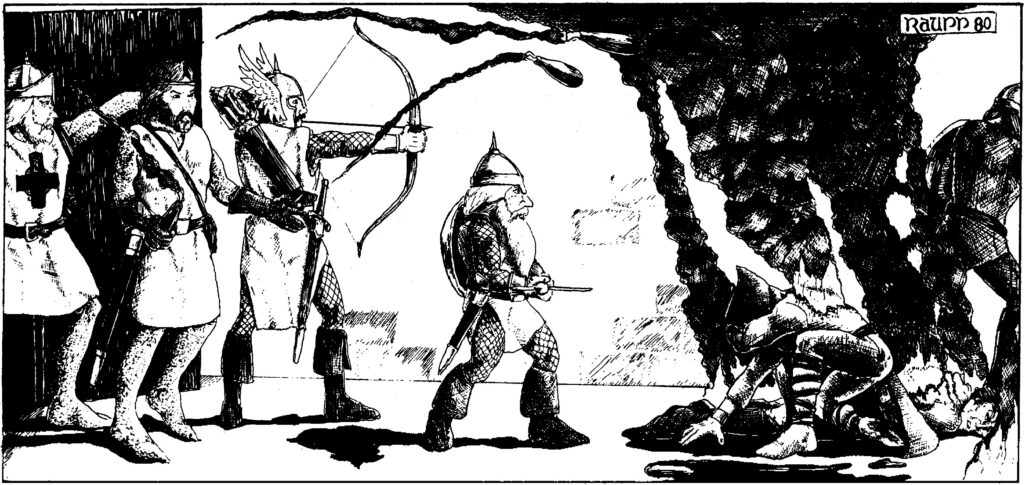
Once, in a Chaosium RuneQuest® campaign that involved looking for a lost city in a big swamp, my character wanted to bring lots and lots of rope—about 1,000′ of it, in fact. RuneQuest gives the weight and breaking strength for rope (AD&D gives nothing but a price). According to the third-edition RuneQuest Gamemaster Book, a 30-meter rope that weighs 6 kg has a strength of 366 kg. Converting this to the D&D game’s standard 50′ rope, that would mean that a 50′ rope would weigh 6.7 lb. and be rated at 805 lb.

That sounds good, except that there are lots of different sizes of rope, and adventurers have uses for many of them. In addition, a quick look at a table of rope strengths would seem to contradict RuneQuest’s numbers. According to Mark’s Handbook,1 standard fiber rope sizes start at 3/16” and go up to 4”. The weight of a 50′ manila rope varies in that range from 12 ounces to 219 pounds! And the breaking strength. varies from 450 lb. to a whopping 105,000 lb. The size closest to RuneQuest’s weight of 6.7 lb. per 50′ is 11/16″ rope, which has a breaking strength of 4,400 lb.

Fiber rope is usually made out of plant fibers; hemp, jute, and manila are the most common. These ropes are cheap, strong, and relatively durable. The biggest problems with rope are rotting and simple wear.

The strength of rope is its breaking strength. You have to understand that a rope with a 1,000-lb. breaking point breaks if you try to lift 1,000 lb. with it. Now, suppose you try to lift 980 lb. with it. It’s just possible, if you apply force very gently to the rope. Jerk on that rope with more than 20 lb. of force, and the rope breaks.

In practice, ropes are used in situations in which jolts, weights that fall before they run out of slack, and other sudden loads are routine. To allow for this, ropes should only be subjected to forces at most only one-quarter of their breaking strength.

Rope: Size, Weight, Strength, and Cost

Properties of Manila Rope2

Diameter (inches) Pounds per 50’ Breaking strength (lb.) Useful strength (lb.) Cost per 50 feet
 D&D  AD&D RuneQuest
3/16 0.75 450 110 1 sp 2 cp 5 p
1/4 1 600 150 2 sp 3 cp 7 p
3/8 2 340 1,350 3 sp 6 cp 14 p
1/2 4 2,650 660 6 sp 12 cp 27 p
11/16 7 4,400 1,100 10 sp 20 cp 45 p
3/4 8 5,400 1,350 12 sp 25 cp 55 p
1 14 9,000 2,250 2 gp 4 sp 90 p
1 1/2 30 18,500 4,600 4 gp 8 sp 180 p
2 50 31,000 7,750 8 gp 15 sp 340 p
3 120 64,000 16,000 15 gp 30 sp 675 p
4 220 105,000 26,000 25 gp 50 sp 110 p

Going back and applying that to our 11/16″ rope, the 4,400-lb. breaking strength shrinks to a 1,100-lb. working strength. Furthermore, that strength is for manila rope, which isn’t available everywhere (for example, you can’t grow the plant in Europe). For agava or jute ropes, the value would be 825 lb. This is very close to RuneQuest value of 805 lb., so we know that Chaosium did its homework here.

Still, why settle for just one type of rope? The Properties of Rope Table applies to manila rope, which is the best sort. Agava or jute ropes are two-thirds as strong as manila.

Thus, my character’s 1,000-foot supply of rope would weight 134 lb. Is chose the 11/16” baseline, with a working strength of 825 lb. But suppose he’s okay with a lower working strength? With 3/8” rope, his thousand-foot coil of rope weights only 40 pounds, with a working strength of 340 lb. (manila rope) or 228 lb. (jute). Tempting.

A Thousand and One Uses

“Rope!” he muttered. “No rope! And only last night you said to yourself: “Sam, what about a bit of rope? You’ll want it, if you haven’t got it: Well, I’ll want it. I can’t get it now.” — Sam Gamgee

Finally, what can you do with 50′ of rope? Here are a few ideas. Think about them—and make up some new uses for this most useful piece of adventuring equipment.

    1. Tying horses to trees or posts.
    2. Climbing and rappelling.
    3. Lowering a lantern to see what’s at the bottom of a shaft.
    4. Lowering a kobold to see if the monster at the bottom of the shaft is hungry.
    5. Creating trip lines for traps.
    6. Keeping prisoners out of trouble by tying them up.
    7. Lashing together stretchers for wounded characters.
    8. Creating handy bridges and rope walks.
    9. Going after big fish.
    10. Winching doors and boulders out of the way.
    11. Winching out supports to collapse roofs (this one’s fun at parties).
    12. Providing support to keep from falling out of a tree after being chased up there by a monster.
    13. Knitting sweaters for giants (using spears for knitting needles, of course).
    14. Making hammocks if a large piece of cloth is available.
    15. Making clotheslines so you can wash everyone’s smelly adventuring clothes.
    16. Holding up large boulders until monsters walk under them (another favorite party trick).
    17. Dragging things you don’t want to have near you (like cockatrice bodies or dead rust monsters).
    18. Forming rope skeins for catapults.
    19. Swinging Tarzan-like across rifts.
    20. Hanging particularly obnoxious enemies.

And, by the way, no, ropes are not available in decorator colors except in Elven lands.

Footnotes

  1. Lionel Simon, ed. Mark’s Standard Handbook for Mechanical Engineers, Eighth Edition. McGraw-Hill Books (New York, 1978), pages 6-152 and 8-93.
  2. Information for this table was taken from Mark’s Standard Handbook for Mechanical Engineers, page 8-93.

Don’t Drink That Cocktail—Throw It!

This was my first-ever full-length paid article.

From The Dragon Magazine, Issue #40, August 1980

Don’t Drink That Cocktail—Throw It!

by Robert Plamondon

Festus the Dwarf kicks open the wide door of the bandits’ dun­geon home and throws in two molotov cocktails, burning one of the twelve bandits to death and wounding two more. Right behind come Rangers Smith and Jones and Cleric Lucretia, who each lob two smoking oil flasks. Before the bandits can react, over half receive serious bums and several are dead. The pools of flaming oil prevent them from regrouping. With sword and bow, the invaders pick off the survivors and take the room. None of the adventurers has taken a hit.

Many players, like those mentioned above, have realized that flaming oil is the most powerful weapon available to a low-level player in AD&D. A flask of oil burning on a monster (or player character) does 3-18 points of damage in the space of two rounds and can be used by all character classes except Monks. Compare this to a “paltry” 1-10 points of damage done by each hit of a two-handed sword.

Because the players in my dungeon were using so much oil and frying monsters so consistently, I decided to investigate the use of oil in AD&D. I wanted to simplify the combat system for oil, and I wanted to burn my players a little.
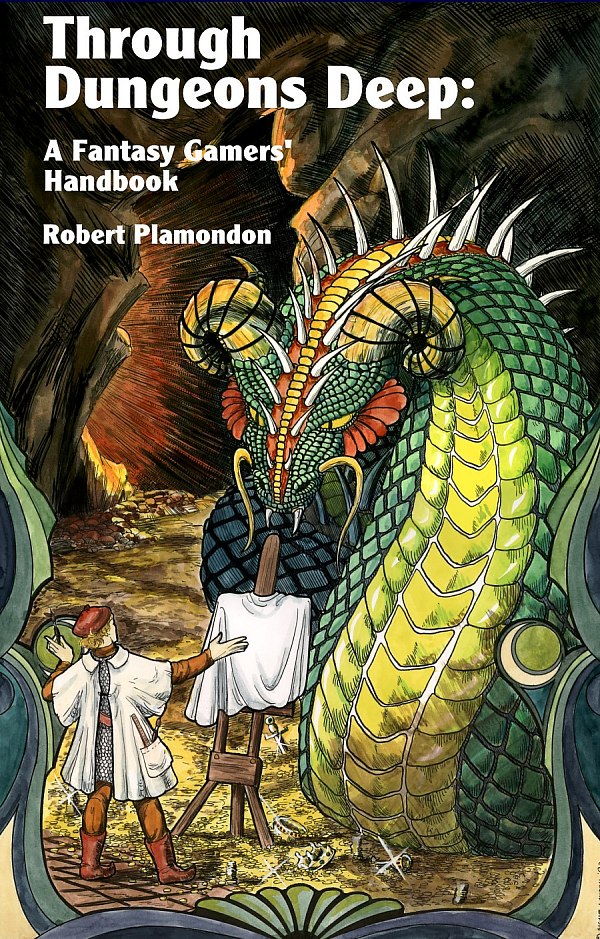
A common technique for using burning oil is to first toss an oil flask onto the target, then light it with a torch. This method is useful when you need a wall of flame between you and the monsters, but takes a long time to set up—grab oil, throw it, grab a torch, throw it—and requires two hits to torch one target.

Molotov cocktails are a more elegant method of creature crisp­ing. In its simplest form, a Molotov cocktail is an oil flask with a rag stuffed in the mouth. The rag is lit before the oil is thrown, and the rag lights the oil when the flask breaks. Instant monster flambé!

The stout-hearted can manufacture Molotov cocktails during me­lee by opening oil flasks and stuffing rags into them. Those with more foresight will have some made in advance. Preassembled Molotov cocktails can be used more quickly, but tend to soak their immediate surroundings with oil, endangering whoever carries them.

Classier models have a cap over the wick, which prevents oil leakage. These caps can be of metal, which can be pulled off or unscrewed, or of waxed paper or parchment, which can be burned or torn off. Molotov cocktails assembled with wicks going into the oil are preferred because they can burn for hours and be used as lamps or incorporated in a delayed-action booby trap.

The best Molotov cocktails have their paper caps and wicks impregnated with saltpeter, so they will light from a spark or a hot coal. Saltpeter is what makes gunpowder burn faster than other smelly charcoal fires. It can be obtained from nitrate deposits in caves; alchemists use lots of it. Molotov cocktails of the most elabor­ate sort will cost from thirty to forty silver pieces.

If your players are suicidal or use lots of traps, they’ll love self-igniting oil flasks. Alchemists in most universes (including this one) discover phosphorus at one time or other. White phosphorus has the charming property of burning spontaneously in air but not in oil. Thus, when a flask of oil and phosphorus breaks, the phosphorus is exposed to air and everything bursts into flame.

These devices are extremely dangerous. A fall, a fumble, or an attack can break the flask and torch the user. This danger makes alchemists reluctant to make phosphorus-oil flasks. Those who agree to make them will charge from twenty to fifty gold pieces each.

Torches, the most common source of flame, will quickly light even a reluctant wick. They are, however, bulky and almost impos­sible to shield, hindering weapon readiness and stealth.

Lanterns can be used to light wicks if plenty of time is available. In melee it is more practical to use the lantern itself as a Molotov cocktail rather than trying to light things from it.

Two non-bulky, easily concealed fire sources are punk and slow match. Punk is fungus-decayed wood; slow match is specially treat­ed rope or cord. Both smolder without flame at the rate of thirty inches per hour (five inches per turn).

Saltpeter-impregnated wicks light immediately from smoldering material; lanterns and simple Molotov cocktails will light after a few seconds of blowing on the match or punk to heat it up.

Various sorts of shields and holders can be made for punk and slow match to hide their glow and leave both hands free. Wind does not blow out the burning ends, but care must be taken to shield them from dampness.

Punk is available everywhere, but slow match is used mostly in cities to light streetlamps. Both are cheap, about one copper piece per foot.

The number of oil grenades that a character can throw in a round depends on the complexity of the operation. Thus, oil flasks, self-ig­niting flasks, and lit Molotov cocktails can be thrown at the rate of three per round. Unlit Molotov cocktails can be lit and thrown at the rate of two per round. Stuffing a rag into a flask, lighting and throwing it can only be done once a round, as is also the case for throwing a flask and then throwing a torch.

These rates of fire assume that the oil grenades are thrown singly at a distinct target and that the grenades are close at hand. Obvious­ly, dumping a backpack full of oil flasks down a stairway will dispose of more than three flasks in a round, while groping through loot and laundry for a flask will slow the rate of fire.

Combat using flaming oil as given in the DMG is unnecessarily complicated. Here is a simplified system:

First, roll the usual d20 “to hit.” If the grenade misses, pick a convenient direction as “12 o’clock” and roll a d12 for the direction of the miss, counting clockwise from “12 o’clock,” in relation to the target. Then roll a d6 for short range, d12 for medium range or 2d12 for long range to find the distance from the target of the point of impact.

Second, roll another d20. A “1” means the flask didn’t break, a “2” means the flask broke but didn’t light (for Molotov cocktails and oil-phosphorus flasks). Any other result means the grenade did what it was supposed to. Unbroken grenades can be thrown again; broken ones can, of course, be lit later on.

A direct hit with any oil grenade does 2-12 points of damage the first round and 1-6 the next round, provided it gets lit.

Splash hits occur when a creature is within three feet of the point of impact of the grenade, provided the creature misses its saving throw vs. poison. Splash hits do 3 points of damage (the DMG spreads this out as one point per segment for 1-3 segments, but it can be applied all at once for simplicity).

Armor doesn’t help reduce damage, because although plate mail, for instance, would keep most of the oil out, what did get through would be where the character couldn’t reach, so it couldn’t be smothered or scraped off.

When a successful attack is made on a person holding an oil flask, there is a one-in-six chance that the flask will be dropped and broken. A person rendered unconscious or killed while holding a flask has a two-in-six chance of dropping and breaking it.

Falling into a pit or down an incline will cause flasks located between the person and the point of impact to break 95% of the time. Flasks located elsewhere will be unharmed. For instance, a flask in a backpack would remain intact if a character fell forward onto his chest or face.

Although flaming oil is a very potent weapon, it is not appropri­ate in all dungeon situations, some of which are examined below:

Some dungeons have wooden floors, thick carpets, layers of straw, or other flammable surfaces. Using oil under these circum­stances can cause a party to burn important treasure, block off their only escape route, or even destroy whole sections of a dungeon.

Destroying the dungeon is not a very bright plan, since the area around the fire will suddenly be filled with monsters. Some of these will be trying to escape the blaze, some hoping to scavenge a hot meal, and a few will try to fight the fire. None of these creatures will be well-disposed towards the arsonists.

Additionally, rumor has it that pyromaniac players are some­times attacked by a huge bear in a flat-brim hat who fights with a +6 shovel.

Using oil in poorly ventilated areas can kill everyone involved because of heat, smoke inhalation, and/or lack of oxygen.

Use of oil in well-ventilated areas will bring the aroma of roasting meat to creatures in rooms connected to the same air shaft, thus attracting scavengers.

Relatively intelligent monsters will learn from experience with oil. Although ogres, lizard men and trolls dislike using flame wea­pons, orcs, goblins, hobgoblins and kobolds will gleefully use flam­ing oil on adventurers once they learn how potent a weapon it is. Players should try not to educate the opposition.


Runngus’ Game by Tom Wham

This was in the days when The Dragon (later renamed to Dragon Magazine) might contain anything, including board games! For example, #40 contained a copy of Runngus’ Game, a spin-off of Tom Wham’s hilarious Awful Green Things from Outer Space, which had been included in The Dragon #28.

On a more personal note, being published in The Dragon and other RPG magazines gave me a taste for writing, and my first book, Through Dungeons Deep—which is still in print, and you should buy a copy—came out the next year.

Cover of Through Dungeons Deep, based on an actual gaming session.

My Magic Items from Dragon Magazine

When I and the world were young, my professional writing career got its start with a tiny piece in The Dragon, the D&D magazine from TSR Hobbies. This was my writeup of a humorous cursed magic item, The Rod of Singing, appearing in their Bazaar of the Bizarre column. They paid me money for it!

In the end, I sold them three magic items in 1980 and 1981, reproduced below. I went on to write many other articles and eventually a whole book, Through Dungeons Deep: A Fantasy Gamers’ Handbook (Reston Publishing, 1981, reprinted much later by me under my Norton Creek Press label).

Rod of Singing

by Robert Plamondon, The Dragon #37, May, 1980

The Rod of Singing is a magical item usable by both Clerics and Magic-Users, although neither class will appreciate its charms.
When discovered, the Rod behaves like some useful rod (pick one from Greyhawk or DMG, but between five and 30 minutes after picking up this device, the magician or Cleric will begin to wave it as if conducting an imaginary band, singing loudly and off-key. This noise has a one-third chance per turn of attracting wandering monsters and, if the monsters are intelligent, with a -1 reaction penalty due to the poor music quality.

The rod prevents the casting of spells by interfering with speaking and gesturing. It adheres magically to the hand and can be removed only by a Remove Curse or Wish spell. The person under the rod’s control will continue singing as long as he is conscious and will resist attempts to knock him out.

Bell of Pavlov

By Robert Plamondon, Dragon #45, January 1981

The Bell of Pavlov appears to be a small silver handbell, but when rung it causes those within a 30-foot radius to salivate uncon­trollably.

The rate of salivation is too high to allow speaking and thus makes casting spells with verbal components impossible.

In addition, there is a 20% chance that people affected by the bell will suddenly decide to have a meal, even when currently engaged in combat.

Experience point value: 1,000
Gold piece sale value: 3,500

Ruby Slippers

By Robert Plamondon, Dragon #45, January 1981

These magical slippers are bright red in color. They allow the wearer to teleport to his or her home by clicking the heels together three times and murmuring, “There’s no place like home, there’s no place like home, there’s no place like home.”

Ruby slippers cannot be removed intact from the feet (once they are put on) until the owner dies or a Wish or Limited Wish spell is cast. They are nearly indestructible and save on the Item Saving Throw Matrix as Hard Metal, with an extra + 2 on the roll. They also give the wearer immunity to foot ailments.

The Slippers can only be used once per day. They can transport the wearer and up to 2,000 gold pieces in weight of living and/or non­living matter; but only to the wearer’s true home (where the heart is). The activation routine takes two segments.

Ruby Slippers are usable by all character classes.

Experience point value: 1,000
Gold piece sale value: 5,000